
Hike leader: Edwin Case
Narration by Lane Harris
In the past, whenever I heard someone mention the Rocky Ridge Trail and Rocky Rim Trail, I always thought to myself, are they referring to the same trail? Or are there two different trails? I honestly didn’t know. A quick map check helped clear up the confusion for me: The 6-mile Rocky RIM Trail #1572 runs west to east just north of Fish Lake and then continues south along Rocky Ridge until it intersects with the Rogue-Umpqua Divide Trail (#1470). The 2-mile Rocky RIDGE Trail #1571 begins near the Rocky Ridge Shelter and runs south and ends at the point where it intersects with the aforementioned Rocky Rim Trail #1572. The ridgeline itself is called Rocky RIDGE. And now, dear reader, you are also no longer confused… right?..
Edwin, who was tagged to lead the group, led the Rocky Ridge Renegades (yes, I just made that up) up the Rocky RIDGE Trail which took us to the Rocky Ridge Shelter (you remember this from the above lesson, right?) From there, the trail continued through the deep forest. This portion of the trail had a fair number of downed trees to negotiate around, over or under (This seems to be a running theme lately for this group) Fortunately, there were no difficult showstoppers, but the trees did manage to slow our pace some.
Shortly after the Rocky Ridge Trail intersected with the Rocky Rim Trail, we made a slow climb through a burned area before reaching an outcropping with a breathtaking view of Fish Lake below. From this vantage point, we could also see Rocky Ridge itself, sitting high above us to the southeast. From here, the trail narrows and hugs the mostly baren hillside as hikers take advantage of gabion baskets which make the going easier (more on that later) We continued as the path made a gentle ascent towards Rocky Ridge.
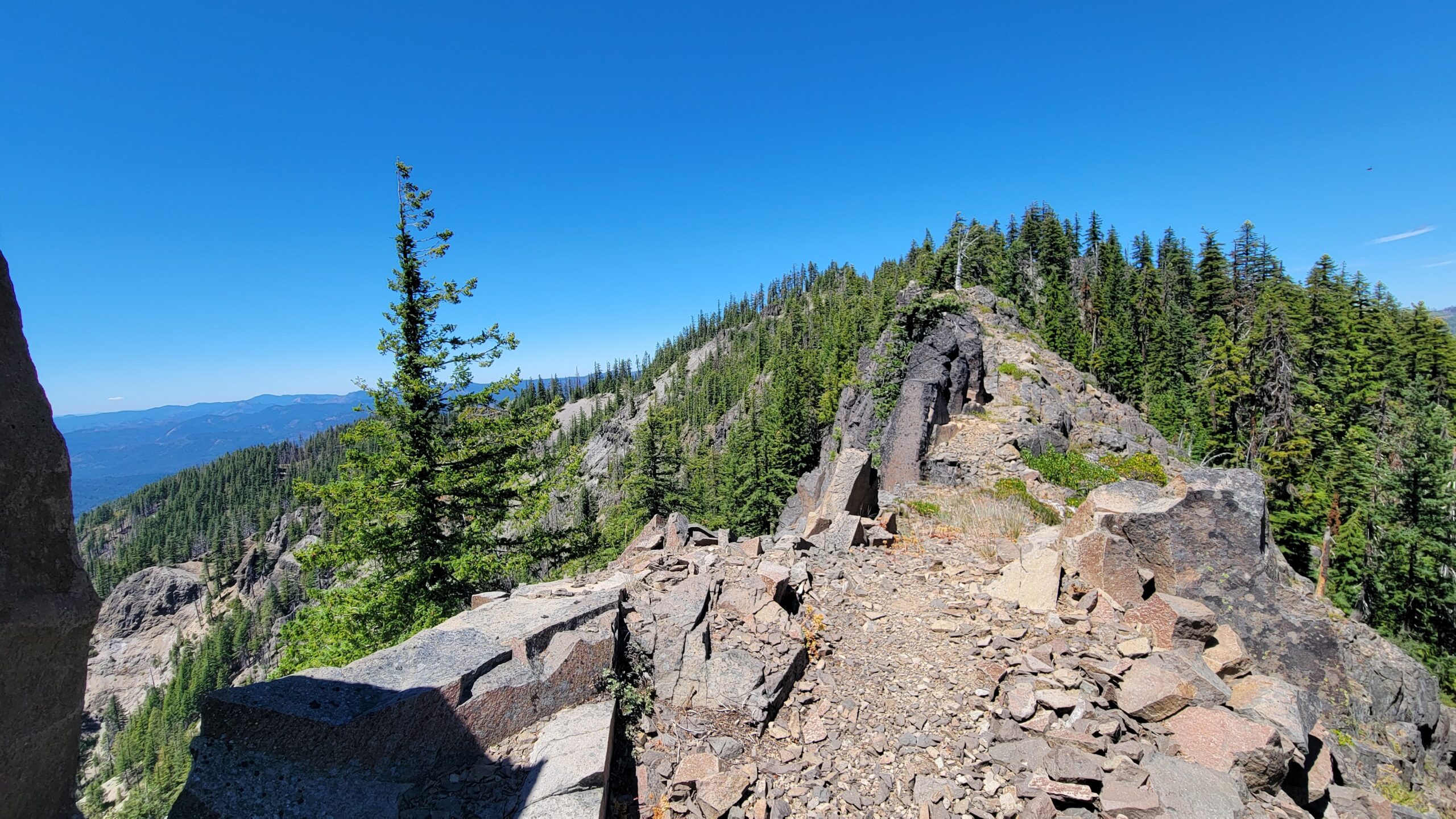
Arriving at the ridgeline is either thrilling or chilling, depending on how you deal with heights. The trail becomes very narrow as it meanders along the spine of the ridge, with the edges dropping off somewhat unsettlingly to parts unknown. Although it’s not what most would define as death-defying, the path does require one to pay attention to where their feet are. For most of us, it was thrilling, as we gleefully and carefully strolled along the top of Rocky Ridge. For a few of us, it was probably more chilling, as Colby and Barbara stayed behind on the north side as the rest of us trekked on. Barbara does deserve some credit though, as she initially made it part way down the spine before she decided that the thrill was becoming more of a chill, and abruptly turned around and joined Colby at chicken point.
The rest of us continued about a mile further down the trail where we enjoyed easterly views. At our 6000-foot elevation lunch spot, we could see Mt Thielsen, Mt Bailey, and even the rim of Crater Lake. On this picture-perfect blue-sky day, the views just couldn’t get any better!
On the way back, we marveled again at the vistas from Rocky Ridge, mostly to the west where Fish Lake sits. After a quick head count, we departed Rocky Ridge and started our way back down the hill. Same trees to clamber over, just a different direction.
And now, time for a history lesson…
On the way back down the trail, John Malone shared the story of when he had done some trail maintenance on this trail back in the mid 90’s. John had coordinated with the Forest Service, which had agreed to supply all the materials for this project. He and another fellow spent several months constructing gabion baskets for sections of the trail that were in danger of just giving way. For those who are not aware, gabion baskets are rectangular containers, typically made of galvanized steel wire mesh which is filled with stones or other available debris. They are commonly used for erosion control, retaining walls, and landscaping projects. The porous nature of gabion baskets allows for water drainage while providing a strong, stable structure. (Thank you, Google!) The pre-built and folded gabion baskets took several days to be hauled in by mules, as was their drinking water. Once all the supplies were delivered, it was time to get to work. During these months, they would arrive on Monday, work Monday thru Thursday, and then hike out and go home. Then come back and do it again, over and over for 3 months! He explained how they had to dig far enough into the hillside for the gabion baskets to have a solid surface to sit on. Then, they would use the rock and debris to fill the gabion baskets with. This was back-breaking work! (Some of John’s handiwork is pictured below, and is also seen in the video)
I made sure to thank John for his hard work back when he was 30 years younger. I have no doubt that if these gabion baskets were not installed, that the trail going up to Rocky Ridge would be nonexistent, and that today’s hike would never have happened.


Note: The Rocky Ridge Trail #1571 connects with the Rocky Rim Trail #1572